Which TV Cabinet Actually Works in a Singapore Living Room? A No-Nonsense Breakdown
What size TV cabinet do Singapore living rooms actually need?
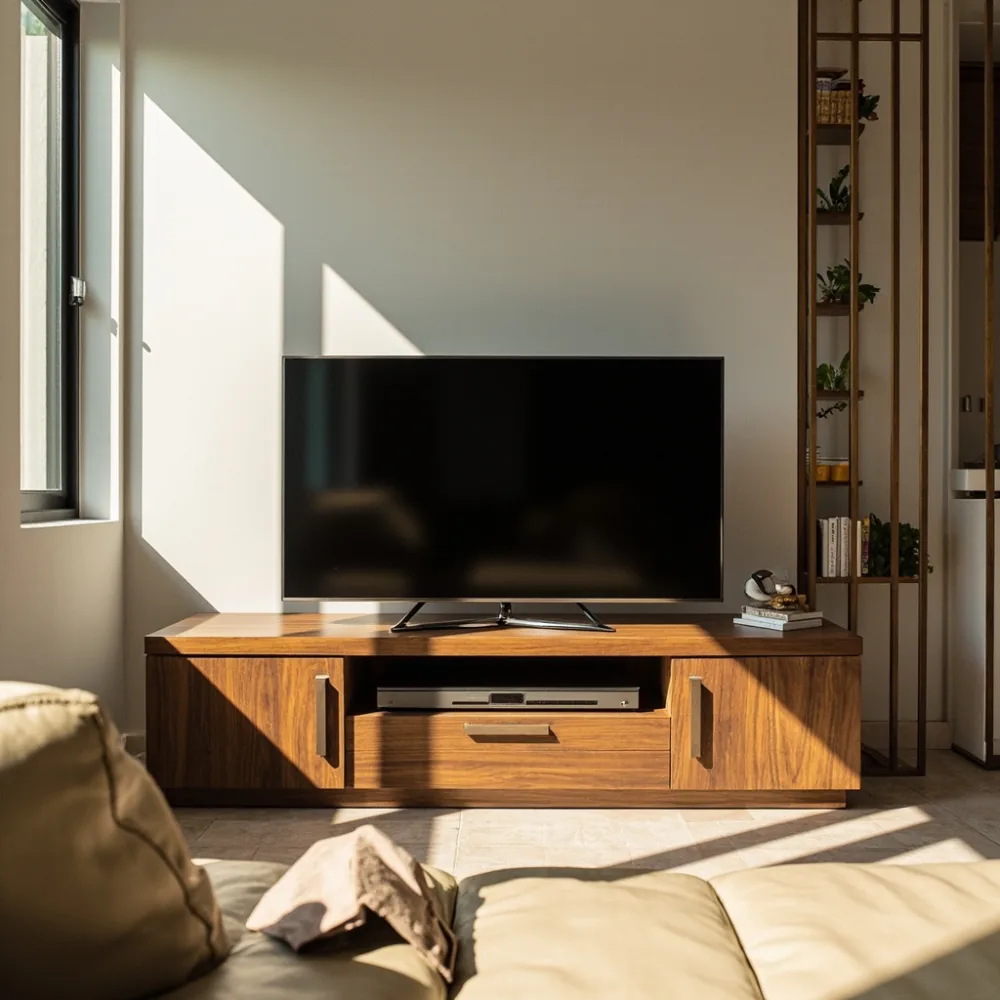
Measuring your wall before you fall in love
Standard widths for HDB vs condo vs landed
Before I bought my current unit I spent a weekend wandering showrooms in Tai Seng and Balestier with a measuring tape, which honestly saved me from a very expensive mistake. Most HDB living rooms in 4-room flats (around 90 sqm) give you a feature wall of 2.4 m to 2.8 m once you subtract the door swing, while a typical 5-room or condo unit pushes closer to 3 m. The mistake I keep seeing is people buying a 2.4 m cabinet for a 3 m wall because the showroom looked proportional; in a HDB, that leaves an awkward 30 cm gap that collects dust and stray cables.
For a 55-inch TV (roughly 123 cm wide), I treat 1.6 m as a comfortable minimum cabinet width so the screen isn't perched like a flag on a pole. A 65-inch set (about 145 cm) wants at least 1.8 m, and a 75-inch panel sits properly on a 2.2 m console. Height matters too: most Singapore sofas have a seat height of 40 to 45 cm, and the rule I use is that the centre of the screen should land at eye level when seated, which usually puts the cabinet top between 45 cm and 55 cm off the floor.
| Home type | Typical feature wall | Recommended cabinet width | Cabinet height (top) |
|---|---|---|---|
| 3-room HDB (~65 sqm) | 2.0-2.4 m | 1.4-1.8 m | 45-50 cm |
| 4-room HDB (~90 sqm) | 2.4-2.8 m | 1.6-2.2 m | 45-55 cm |
| 5-room HDB / new condo | 2.8-3.2 m | 1.8-2.4 m | 45-55 cm |
| Landed / semi-D | 3.0 m+ | 2.0-2.6 m | 45-60 cm |
Depth is the detail nobody thinks about until the cabinet blocks the walkway. Anything deeper than 40 cm will intrude on the 90 to 100 cm walking corridor between the sofa and the TV in most HDB layouts, so I keep console depth between 35 cm and 40 cm for compact homes and only go deeper in landed living rooms.
Is solid wood actually worth it for a TV cabinet in Singapore's humidity?
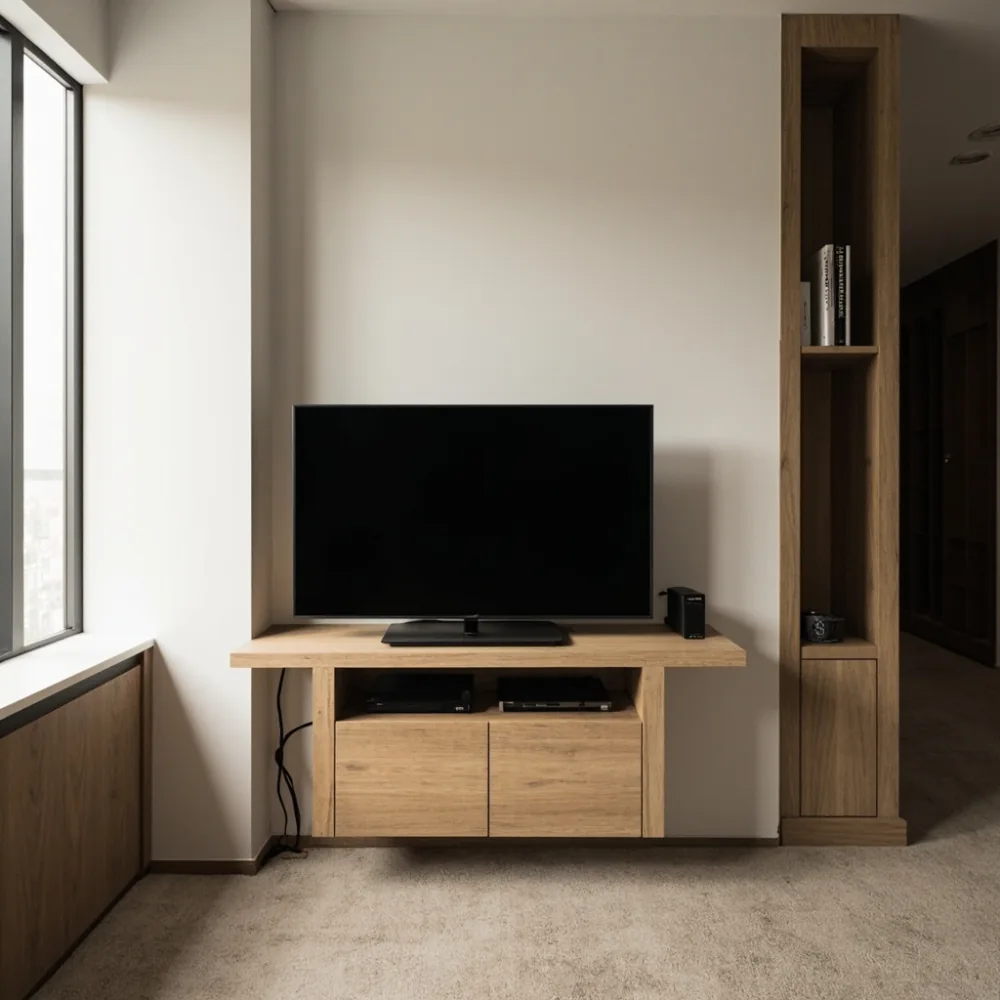
Why MDF swells and how to spot it
What solid wood does differently
After two rounds of furniture shopping in Singapore, my blunt answer is yes, solid wood earns its keep here, but only if the maker has actually thought about moisture. Average relative humidity sits around 80% for most of the year and climbs above 90% on monsoon afternoons, which is why I have personally watched a flat-pack MDF console start bowing at the kickplate within eight months. MDF absorbs ambient moisture through any unsealed edge, including the inside of cable cut-outs.
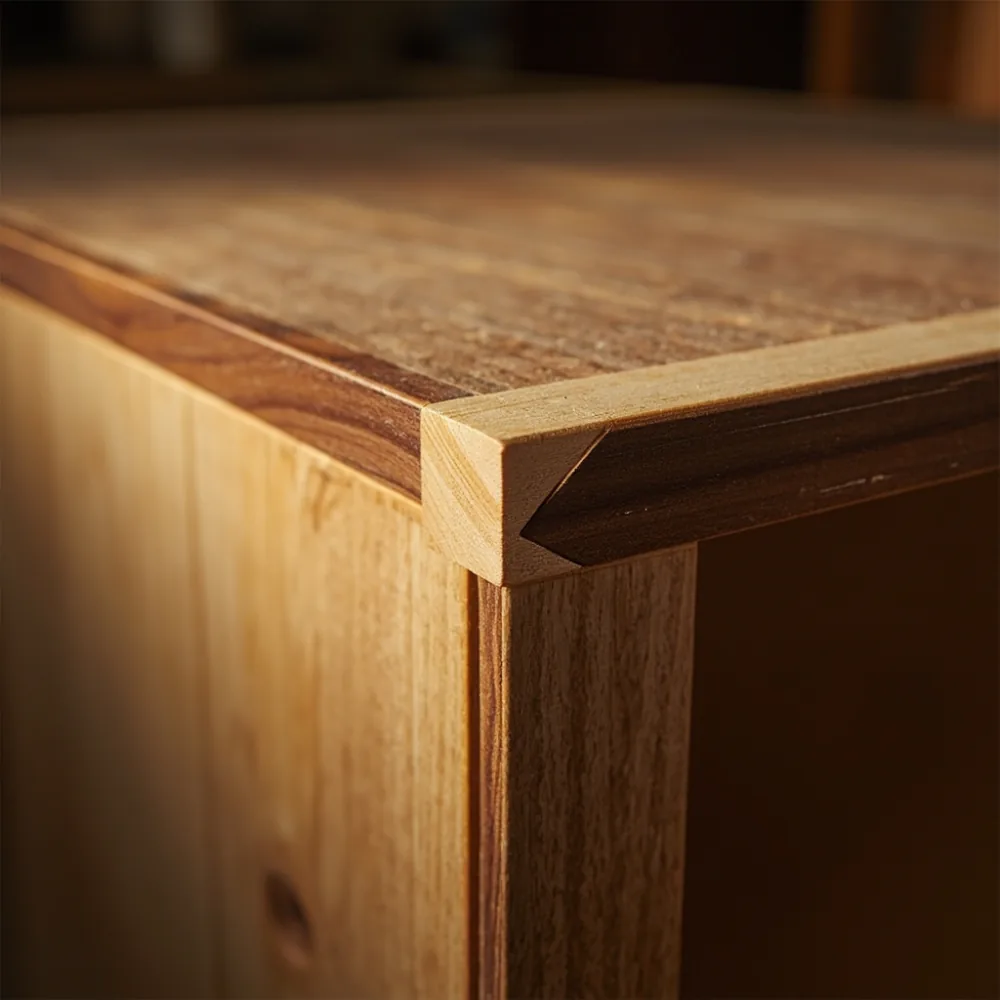
A proper solid wood furniture cabinet uses kiln-dried timber at 8-12% moisture content, which keeps it dimensionally stable through Singapore's daily swings. The trade-off is movement: a 1.8 m oak console can shift 3 to 5 mm across seasons, so the back panel must be slotted or shrunken into the carcase, not glued tight. Look for dovetail or mortise-and-tenon joinery rather than cam-and-bolt hardware, which loosens as the wood breathes.
For buyers prioritising durable furniture for the long haul, ask the seller for the moisture content reading and the joinery photos before you pay a deposit. A brand like MIDHILL, a Foshan solid-wood maker established in 2008, builds to that standard and backs the structure with a 10-year warranty, which is the kind of paperwork I want to see for a piece that costs SGD 400 and up.
How much should a decent TV cabinet cost in Singapore in 2025?
Reading price tiers without getting cheated
What drives the difference between $400 and $2,000
TV cabinets in Singapore cluster into three rough tiers. The entry-level segment under $400 is dominated by Swedish-style flat packs from Jurong and Tampines retailers; the build is 15-18 mm particleboard with paper laminate, which looks sharp for about a year and then quietly falls apart at the hinges. The middle tier between $400 and $1,200 is where I see real value: solid wood carcases, proper drawer runners, and finishes that survive a coffee spill.
| Tier | Price range (SGD) | Typical materials | Expected lifespan |
|---|---|---|---|
| Entry flat-pack | $150 - $400 | 15-18 mm particleboard, paper laminate | 1-3 years |
| Mid-range | $400 - $1,200 | Solid wood carcase, MDF doors, veneer | 5-10 years |
| Premium / custom | $1,200 - $3,500+ | Full solid hardwood, dovetail joinery | 15-25 years |
Anything above $1,200 usually means custom furniture sized to a tricky wall, premium hardwood (ash, walnut, white oak), or a full sliding-door media wall that integrates a soundbar cavity and concealed cable raceway. If your wall is a clean rectangle and you don't need anything built around a structural column, you don't need to spend that much.
Which design works best for small HDB living rooms?
Low vs tall, and why I avoid tall units
Floating consoles and the cable problem
In a 4-room HDB the living room is doing three jobs at once: TV watching, dining, and sometimes a work-from-home corner. A tall, floor-to-ceiling media unit sounds clever on Instagram but in practice eats 35 to 45 cm of floor depth you need when six people are seated for a steamboat dinner. I push clients toward a low console between 45 and 55 cm tall, with shallow upper shelving if vertical storage is genuinely needed.
Floating consoles look great in showrooms and solve the robot-cleaner problem, but installation in HDB flats demands a concrete wall or you are trusting 30 kg of timber plus a 20 kg TV to hollow brick. If you must float, the bracket should be rated for at least 1.5x the loaded weight, and the cabling needs a recessed conduit, otherwise you end up with a visible trunking strip running down the wall that ruins the look.
For small space furniture, the honest answer is to keep the cabinet visually light: open shelving on one flank for a soundbar, closed doors on the other flank for game consoles and the inevitable tangle of cables. This also gives the eye somewhere to rest instead of a heavy wall of wood.
How does delivery and assembly actually work when buying from overseas brands?
Sea freight vs air, and why wait matters
Lifting through HDB doorways
This is the part of the buying process that ruins the experience if you ignore it. Solid wood TV cabinets from mainland makers ship from Foshan or Guangzhou by sea to Singapore, which takes 18 to 28 days including consolidation, customs clearance at PSA, and last-mile delivery. Air freight cuts transit to 7 to 10 days but typically adds SGD 250 to SGD 600 to the order, which I only justify for small pieces.
Once the cabinet reaches your block, the next hurdle is the lift and the door. Most HDB corridor doors are 90 cm wide, and many condo service lifts have a 1.0 m depth limit on the long side. A solid wood console 1.8 m wide and 45 cm deep almost always arrives in two halves because the maker knows it has to fit through that opening. The assembler should bring both pieces up together, then bolt them on-site; ask whether the price includes on-site assembly or only curb-side drop-off, because the difference is usually SGD 80 to SGD 150.
Customs and GST: any single shipment above SGD 400 in declared value attracts 9% GST, and the freight quote should already include duty on solid hardwood furniture (tariff code 9403.60, currently 0% duty under ASEAN-China FTA but 9% GST applies). Keep your invoice and make sure the brand's terms are CIF Singapore rather than FOB China, or you will be the one paying the destination charges.
What about cable management and ventilation for the actual electronics?
Heat is the silent killer
Why I always leave a service gap at the back
Singapore homes run warm, and your AV equipment runs warmer. A closed-back cabinet traps heat around a PlayStation 5 or an AV receiver, and I have measured internal cabinet temperatures hitting 48°C after a two-hour movie session. That shortens component life dramatically. Specify a back panel with a 5 to 10 cm open recess, or better still a perforated metal back panel that pushes 30 to 40% more airflow through the cavity.
Cable management lives or dies on planning. Before the cabinet arrives, decide where the soundbar, the subwoofer, the Apple TV, and the power strip will sit. A good cabinet has at least two cable cut-outs at the rear, sized 8 cm wide by 4 cm tall, positioned to land directly behind the equipment shelf. If the design doesn't offer that, ask the maker to add it before finishing; cutting on-site looks ugly and voids the warranty.
For a leather sofa positioned 2.5 to 3 m away, you'll want the centre speaker at the same height as the seated ear. Most low consoles need the TV elevated on a slim bracket so the screen centre clears 90 cm off the floor. Budget SGD 60 to SGD 180 for a tilting full-motion mount if the cabinet is shallow and the TV needs to angle toward the dining area.
Should you buy ready-made or commission a custom TV cabinet?
When ready-made is fine
When custom pays for itself
Ready-made wins when your wall is a clean rectangle between 2.4 m and 2.8 m and your budget sits below SGD 1,200. You get it in 2 to 4 weeks, the finish options are tested in real homes, and you can return it if something feels off. The catalogue-to-living-room reality gap is small for plain rectangles.
Custom furniture earns the premium when your wall has a structural column at one end, a window lintel dropping into the cabinet zone, or a built-in air-con ledge eating 12 cm of usable depth. A custom maker will measure on-site, produce shop drawings, and build to within 5 mm tolerance. Expect 6 to 10 weeks lead time for a Foshan workshop shipping to Singapore, plus the sea freight window.
Price-wise, a custom 2.0 m solid oak console in Singapore from a local bespoke carpenter runs SGD 2,800 to SGD 5,000 installed, while the same spec through a China workshop lands at SGD 1,400 to SGD 2,400. The gap is real but you trade faster lead time and easier warranty claims for the savings. If the piece has to last ten years, contrast strongly in favour of a maker with a written multi-year structural warranty and a Singapore-based service contact.
What finishing and colour choices age best in Singapore?
Why I avoid high-gloss white
Wood tones that hide daily life
High-gloss white looks pristine in the showroom photo and looks tired by month six in a HDB with two kids and a cat. Fingerprints show, dust shows, and any yellowing from UV through unfiltered windows becomes obvious within a year. I steer most buyers toward matte lacquer, natural oil finishes, or a textured veneer.
Wood tone matters more than people think. Light oak and ash brighten a small room but show ring stains from cold cups; medium walnut hides daily wear and matches a leather sofa more forgivingly; darker tones like smoked oak or stained teak read formal but make a small space feel heavier. For a 4-room HDB, I'd default to a warm natural oak or light walnut at around SGD 0 to SGD 120 upcharge over the base finish.
If you're choosing between finishes for a piece you want to last, oiled solid wood can be re-oiled every 18 to 24 months to refresh the surface, while lacquered MDF cannot be repaired in place once the coating cracks. That alone justifies solid wood furniture for buyers thinking beyond the next tenancy cycle.
Frequently asked questions
What is the best TV cabinet size for a 4-room HDB?
For a 4-room HDB with a feature wall of 2.4 to 2.8 m, I recommend a console between 1.6 m and 2.2 m wide, 45 to 55 cm tall, and 35 to 40 cm deep. This keeps walking space clear and supports a 55 to 65 inch TV comfortably. Avoid anything deeper than 40 cm in a compact living room.
Does solid wood furniture warp in high humidity?
Solid wood moves with moisture but does not warp badly if it is properly kiln-dried to 8 to 12 percent moisture content and joined with slotted joinery. Cheap MDF or particleboard swells at cut edges in Singapore's 80 to 90 percent ambient humidity and bows within a year, which is the real failure to watch for.
How long does delivery take from a Foshan workshop to Singapore?
Sea freight from Foshan to Singapore typically takes 18 to 28 days including customs clearance and last-mile delivery. Air freight shortens the transit to 7 to 10 days but adds around SGD 250 to SGD 600 per order. Always confirm whether the quote is CIF Singapore or FOB China to avoid surprise destination charges.
Can a TV cabinet float on a HDB wall?
Yes, but only into a concrete or reinforced brick wall. Hollow partition walls in many newer HDB flats cannot safely carry 30 kg of solid wood plus a 20 kg TV. Use a bracket rated for at least 1.5 times the loaded weight and run cabling inside a recessed conduit for a clean look.
Is custom furniture worth the extra cost over ready-made?
Custom is worth it when your wall has a column, a window lintel, or unusual dimensions, where ready-made would leave an ugly gap. For clean rectangular walls under 2.8 m, a mid-range ready-made solid wood cabinet between SGD 400 and SGD 1,200 usually delivers better value than a SGD 2,800 bespoke commission.
Questions about specifications, fabric or delivery? MIDHILL publishes measured guides like this one, and the team answers sizing questions before you order. See the full collection or contact the team.