Solid Wood TV Cabinet Pricing Insights
Solid wood furniture looks simple: a dining table, bed frame, wardrobe, nightstand, sofa, or tv cabinet. Yet two pieces with similar dimensions can carry price tags hundreds of dollars apart. The difference usually comes from timber species, moisture control, joinery, hardware, finishing, and logistics—not merely the number of drawers or the size of the screen.

For Singapore homes, those distinctions matter more than showroom catalogues sometimes suggest. A 180 cm dining table must still pass through a HDB lift or a condo corridor. A 220 cm wardrobe may need to be assembled inside the bedroom. A tv cabinet selected for a Tampines flat must fit both the living-room wall and the delivery route. At MIDHILL, established in 2008 and exporting to more than 15 countries, the 10-year structural warranty and lifetime refinishing policy reflect a practical approach to long-term furniture ownership.
Is timber species the biggest factor in solid wood furniture prices?
Yes, but only when “solid wood” is used accurately. A seller may describe a product as solid wood even when its visible surfaces combine solid timber, veneer, engineered wood, and other components. The material label alone does not reveal the cost structure.

Species carry different prices because of availability, grain, workability, and demand. Hardwoods such as oak, ash, beech, and walnut are commonly used for tables, chairs, beds, and cabinets. Cherry, maple, and other decorative hardwoods may cost more. Tropical hardwoods can also command premiums, but price should be checked against documentation rather than assumed from a rich colour.
Ask for a material breakdown covering the top, sides, back, drawer boxes, shelves, and legs. In a quality wardrobe, for example, the carcass may use one timber and the drawer fronts another. A credible supplier should state which parts are solid wood, which are veneer, and which are engineered board. If every component is called “solid wood” without further detail, treat that as a prompt to request measurements, timber thickness, and product images.
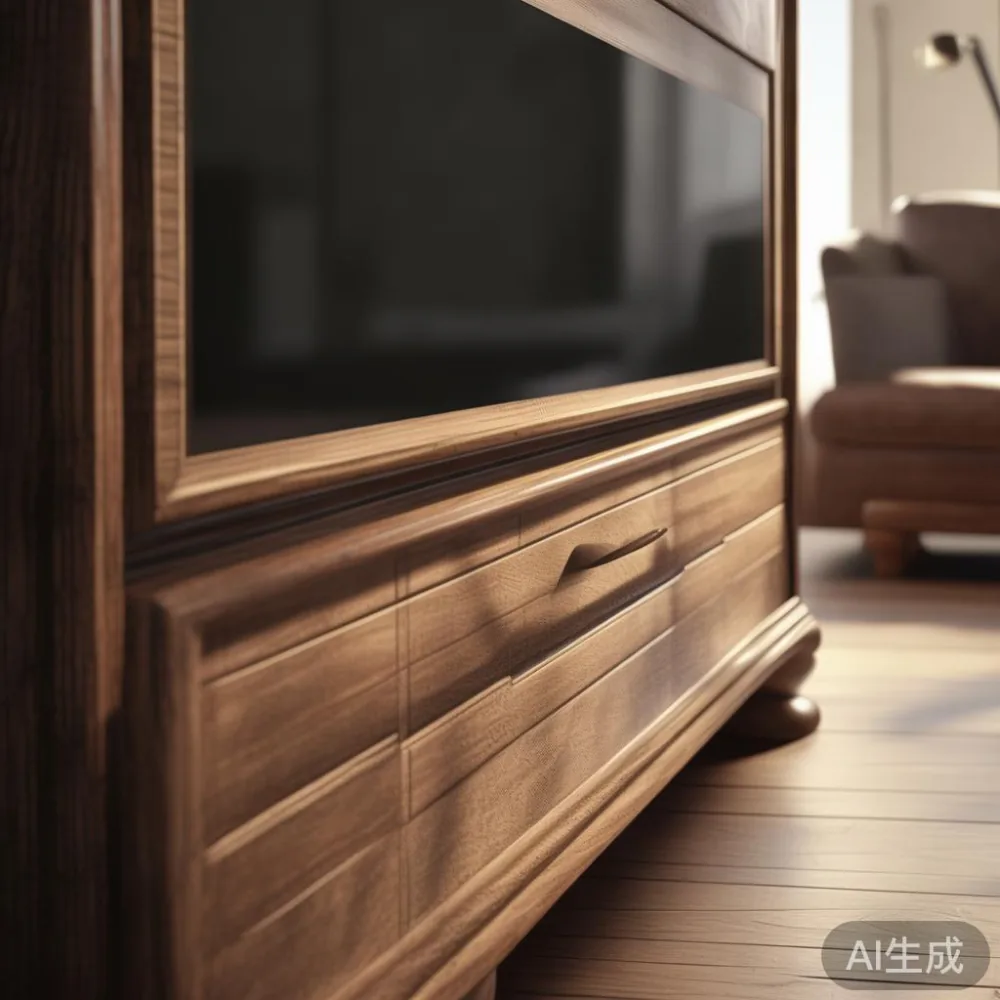
Thickness is a useful comparison point. A 20 mm table top is not equivalent to a 10 mm top in stiffness, repairability, or material use. A 25 mm drawer front, 15 mm shelf, or 18 mm side panel also changes the weight and work involved. The goal is not to identify one universally superior timber; it is to compare like with like.
What makes a well-built dining table or tv cabinet worth paying for?
Cost follows labour and failure prevention. A dining table may look like four legs and a top, but its price can reflect a 4 cm top, tapered or shaped legs, a supporting apron, corner joints, consistent finishing, and a controlled drying process. A slab table can require more preparation than a factory-shaped table because natural edges and grain variations are difficult to align.
Joinery is another price driver. Mortise-and-tenon joints, dovetail drawer boxes, and bridle joints require different production steps from simple screws concealed inside panels. Screws are not a defect when used within a sound engineered design; the important question is whether the joint is appropriate to the load and whether the furniture can be serviced.
For a tv cabinet, hardware can include soft-close hinges, cable-management components, adjustable shelves, drawer runners, and ventilated sections for electronics. A 180 cm model with 2 doors and 2 drawers may weigh 45–65 kg, depending on timber and construction. That weight affects delivery, especially where lift dimensions or corridor turns are tight.
The cabinet must also suit the television rather than overpower it. A 140 cm cabinet for a 55-inch television can look deliberately low-profile; a 200 cm unit for a 75-inch screen can create better balance. Measure the television, wall clearance, skirting, sockets, router position, and viewing distance before choosing the external dimensions.
Last month I visited a showroom and tested several cabinet doors in the same afternoon. Cheap hinges dropped quickly, while well-adjusted hinges closed quietly from roughly 30 cm away. The difference was not the painted finish but the hardware adjustment and cabinet tolerances. That small observation explains why hinge type, runner travel, and assembly precision belong in any sensible price comparison.
How much do drying, machining, and finishing add to the price?
Wood moves as its moisture content changes with humidity. Singapore’s year-round climate makes stability especially important. Furniture made from properly dried timber can perform well here, but buyers should still avoid placing a solid wood dining table directly against an air-conditioning vent or beside a damp balcony wall.
Industrial drying is not one universal step. Kiln schedules, moisture targets, acclimatisation, and machining all affect the outcome. A piece that cracks at a joint or opens a gap along a drawer front may reflect poor moisture control rather than careless use. A supplier with a 10-year structural warranty should be able to explain how it handles movement, warping, and joint failure.
Finishing can add materially to a price. Options include clear lacquer, matte lacquer, oil, stain, wire brushing, distressing, smoked finishes, and fumed tones. French light luxury styling often uses pale oak, cream, or warm natural finishes with restrained profiles. American light luxury often combines substantial timber with darker stains and carefully proportioned hardware. Post-modern light luxury may mix shapes, colours, or materials while retaining clear craftsmanship.
Finish quality should be judged on consistency across large panels, not just a small display sample. Look at joints, drawer edges, undersides, and areas around handles. Ask whether the finish can be repaired. MIDHILL offers lifetime refinishing, which can reduce the long-term cost of a well-made solid wood piece because colour changes and minor surface wear need not end the furniture’s useful life.
Do dimensions, weight, and delivery affect the final Singapore price?
They can. A flat-packed tv cabinet may cost less to transport than a fully assembled wardrobe, but the saving can disappear if it takes 2 hours to assemble in a small bedroom. Conversely, an assembled product may arrive scratched, misaligned, or unable to pass through the entry.
For HDB flats and condos in Tampines, Bedok, and Punggol, buyers should obtain the lift dimensions and doorway width before ordering. A common passenger lift has a door opening around 90 cm and a car interior around 140 cm deep by 110–135 cm wide, though building specifications differ. A 160 cm dining table cannot turn upright through a 90 cm opening unless its narrowest dimension allows it. For a 220 cm wardrobe, flat-packing or on-site assembly may be the practical option.
My colleague once measured a condo delivery route before ordering a bed frame for a Punggol home. The lift was sufficient, but the turning radius at the corridor required the longer component to enter diagonally. A delivery-day measurement saved the move. This is worth doing for any item over 180 cm long or heavier than 40 kg.
Local prices should include GST. For example, a SGD 1,850 dining table becomes SGD 1,962.50 after 9% GST; a SGD 2,400 tv cabinet becomes SGD 2,616. Delivery may be quoted separately, so compare the landed total rather than the product number alone. MIDHILL provides free shipping for orders over US$350, although the exact Singapore quotation and delivery method should be confirmed before purchase.
Check the delivery window, installation charge, and returns process. A 14-day return policy is useful only if the condition requirements are clear. Solid wood furniture exposed to moisture, heat, or improper care may be excluded, so read the terms and retain the packaging where required.
How should you compare solid wood sofa, bed frame, wardrobe, and nightstand prices?
Compare the same construction features across products. A solid wood sofa may use a timber frame, webbing, foam, fabric, and sprung cushions. A low price may reflect a thinner frame or less labour-intensive upholstery rather than inferior timber alone. The frame’s joinery, suspension, cushion density, and removable covers affect both price and longevity.
For a bed frame, ask about the slat spacing, centre support, and load capacity. A queen bed around 155 cm wide may use 12–15 slats depending on the design. The comparison guide how to choose Mid-century modern bed can help buyers assess frame proportions and style, although the construction specifications remain more important than the period label.
Wardrobes require the clearest breakdown because interiors can vary greatly. A 2-door wardrobe may contain fixed shelves, adjustable rails, hanging rods, drawers, and internal fittings. For anyone comparing how to choose Japanese wardrobe layouts, Singapore wardrobes often need a mix of long hanging space, shelves, and drawers for workwear and household items.
A nightstand can be deceptively expensive if its drawer uses solid timber sides, dovetail construction, and a premium runner. A 45 cm model may contain a 30 cm drawer and one shelf. Matching a nightstand to a bed frame may also require checking the finished height, overhang, and colour under the room’s lighting.
Style labels need context. American sofa vs French provincial sofa is useful for comparing scale and character, but a French silhouette with light upholstery can fit a modern condo very differently from a carved American frame. For a guest room, the phrase American for guest room appears in many planning guides, yet the actual dimensions matter more: a sofa bed around 190–210 cm long may need more floor space than a loveseat at 150–170 cm.
Why do some imported solid wood furniture pieces cost less?
Lower prices can come from efficient production, local timber, simpler finishes, direct-to-customer sales, or economies of scale. They do not automatically indicate poor quality. For useful international comparisons, under 2000 American furniture provides a practical budget reference, but currency conversion, dimensions, materials, and delivery terms must still be checked.
Luxury European light luxury furniture often carries a premium for shaped profiles, detailed joinery, veneer work, specialist finishes, and brand development. Solid wood construction can reduce this difference because the timber itself does not carry the entire cost. For buyers interested in luxury European light luxury furniture, the deciding factors may be the balance of a cabinet, the refinement of drawer corners, and whether the product can be repaired after delivery.
A marble table introduces another price variable. The stone may be natural marble, engineered marble, or porcelain with a marble effect. Each has different weight, edge treatment, porosity, and maintenance requirements. A 120 cm marble table can weigh 60–100 kg, so the structural base, lifting method, and delivery route deserve attention.
What questions should you ask before paying for solid wood furniture?
Ask for the timber species, component thicknesses, moisture treatment, joinery, hardware brand, finish type, dimensions, weight, assembled or flat-packed status, warranty terms, and total delivery cost. If the answer is “solid wood” but no species is given, the product may cover several species. That can be acceptable, but the details should be stated honestly.
Request photographs from the rear, underside, inside drawers, and open doors. Check whether legs and rails are solid timber or veneered surfaces. For a dining table, look for stable legs and an apron that prevents unnecessary flex. For a tv cabinet, inspect cable openings, shelf spans, wall fixing options, and ventilation. For a bed frame, review centre support and fixing instructions. For a wardrobe, inspect the hanging sections and drawer runners.
Price is then easier to interpret. A SGD 1,200 dining table with clear specifications and careful construction may offer more long-term value than an opaque SGD 2,200 table with decorative features that were not needed. The right solid wood dining table should fit the room, withstand daily use, and suit the budget without treating an expensive label as proof of quality.
The same discipline applies to every category: a solid wood sofa must be comfortable and soundly framed; a bed frame must support its occupants; a wardrobe must suit hanging and storage needs; a nightstand must be proportioned correctly; a marble table must be handled safely; and a tv cabinet must fit the wall, equipment, and delivery route. That combination of material, construction, service, and logistics—not appearance alone—drives the real price.