Singapore Homeowners' Guide to Humidity & Wood Furniture
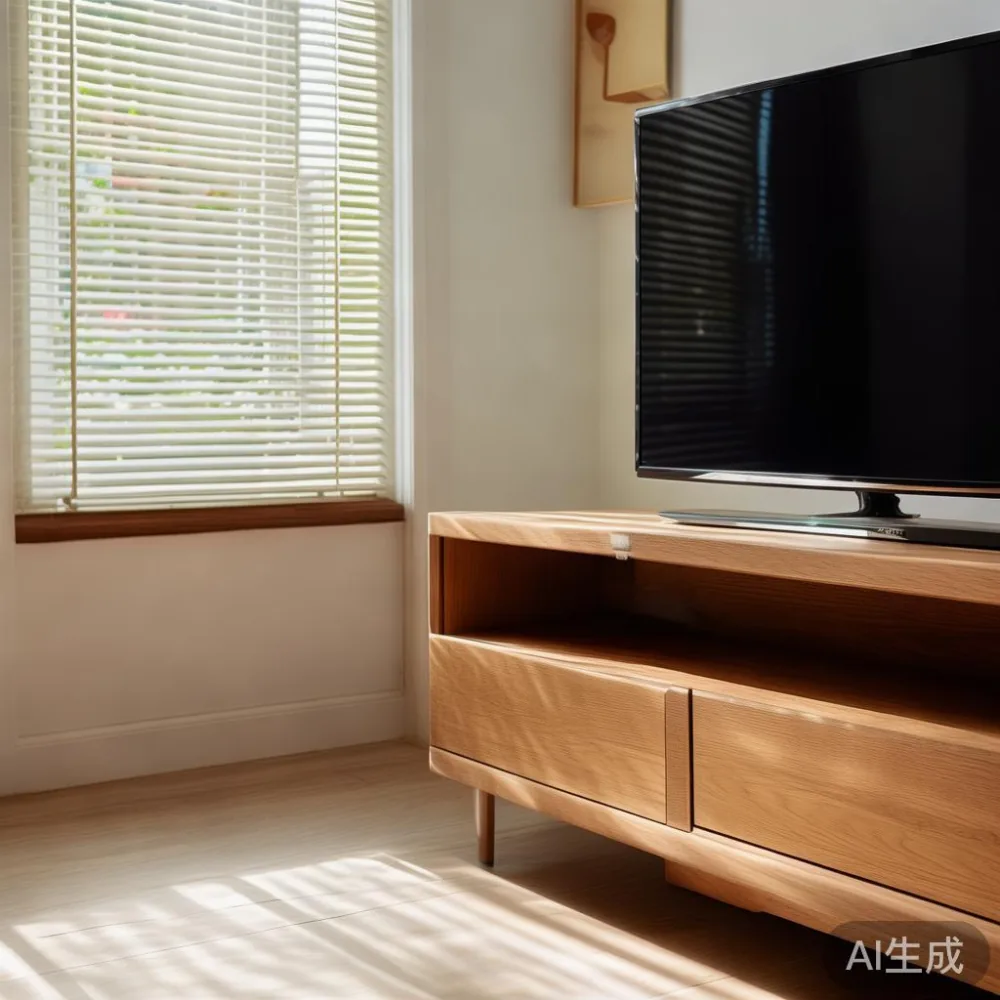
Last month, I drove up to a HDB flat in Punggol to inspect a four-year-old solid wood TV cabinet. The owner had placed it against an external wall in a corner unit, and within minutes I could see the problem: the drawer faces had cupped, one door sat 2 mm proud of the frame, and a faint tide-mark ran along the back panel where condensation had been wicking in from the service yard wall. She had assumed, quite reasonably, that a piece of furniture built for tropical climates would simply cope. It had, by and large — but it had also been quietly telling her that something was wrong. That afternoon, with a hygrometer and a 1.5 mm feeler gauge, I walked her through what was happening to the timber, why it was happening, and what a Singapore homeowner can realistically do about it.
Why Singapore's climate is unusually punishing on solid wood
Singapore sits roughly one degree north of the equator. Relative humidity (RH) in a HDB corridor-block tends to run between 65% and 85% for most of the year, climbing toward 90% during the December-to-February monsoon push and again during the June Sumatra squalls. Daytime temperatures sit between 27°C and 33°C, dropping to 23–26°C at night when air-conditioning kicks in. That swing — warm, damp air outside; cool, dry air inside — is the exact stress pattern that makes timber move.
Wood is hygroscopic. Even kiln-dried oak at 8% moisture content will climb back toward 16–18% within weeks of being placed in a 75% RH room. For every 1% change in moisture content, hardwoods expand or contract by roughly 0.2–0.4% across the grain. A 180 cm long solid wood dining table top can therefore move 2–3 mm along its width over a single season. None of this is a defect; it is just physics. The job of a good furniture maker — and the job of a good owner — is to keep that movement inside tolerances that the joints can absorb silently.
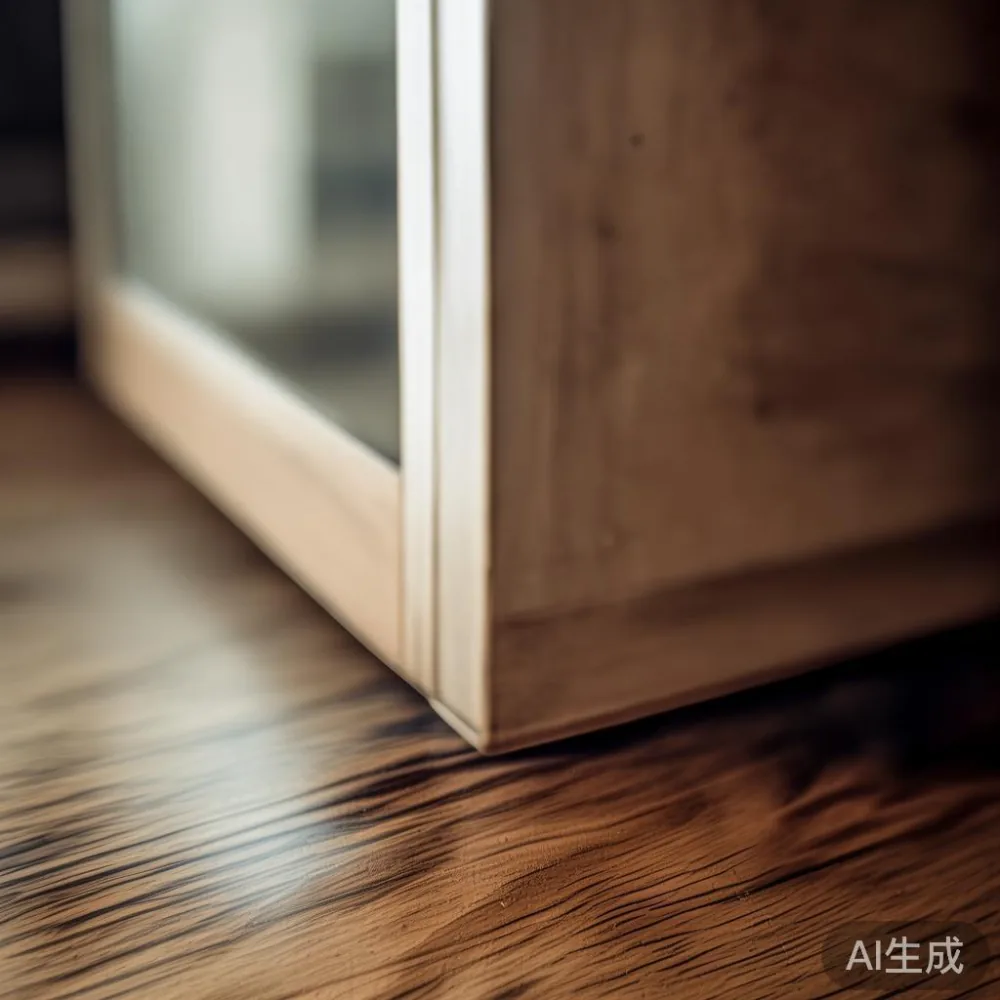
For reference, MIDHILL, a Foshan-based maker working out of Lingzhan Industrial Park, kiln-dries its oak, ash, and walnut to 10–12% before assembly and ships to more than 15 countries, including Singapore. That 10–12% is chosen on purpose: it lands in the middle of Singapore's expected EMC (equilibrium moisture content) range, so the timber neither swells dramatically nor shrinks back hard once it sits in your living room.
Where the damage actually happens on a TV cabinet
A modern light luxury TV console is the most exposed piece of solid wood furniture in a typical HDB or condo layout, which is why we keep coming back to it in this article. It sits against a wall, often a feature wall that wraps onto a divider or window mullion. It carries the weight of a television — typically 15–25 kg for a 55-inch to 65-inch set, easily 35 kg if you mount a 75-inch on the top panel or inside the open bay. It is also, very often, the only solid wood piece under direct evening air-con blast.
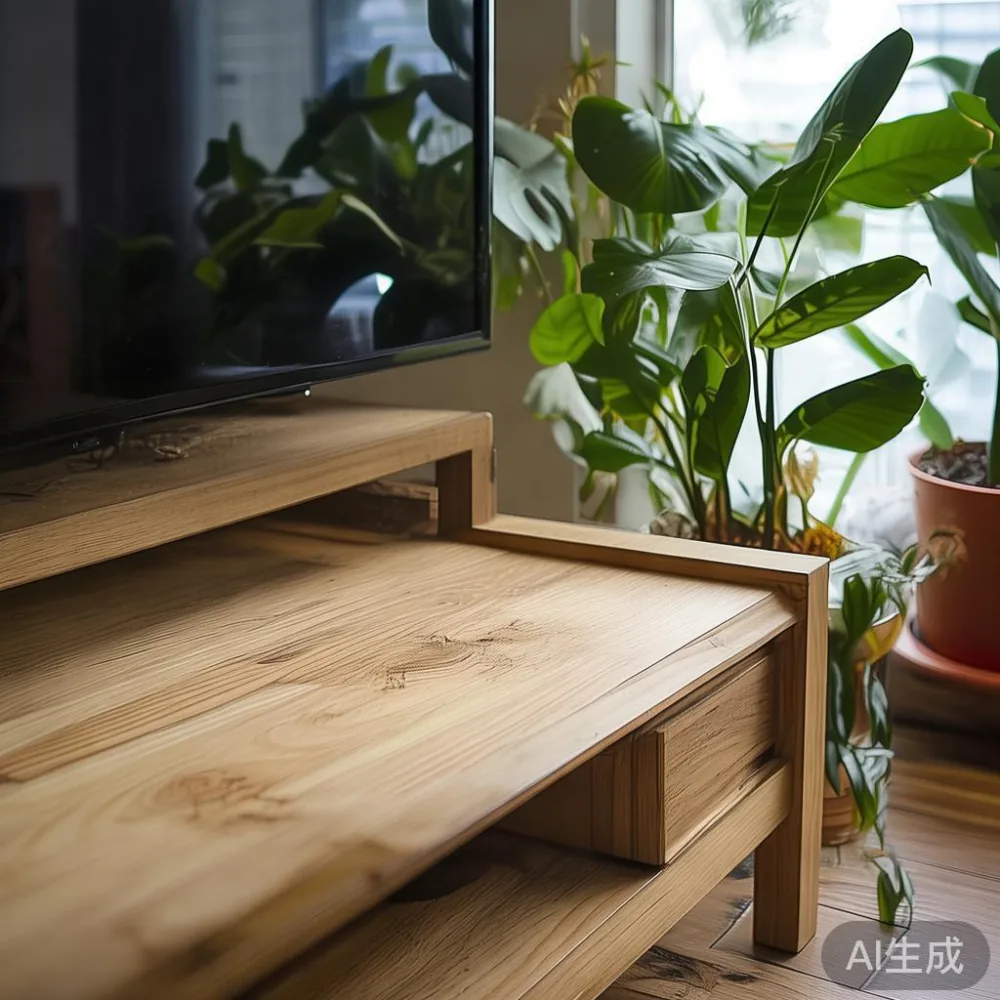
The four failure points I check first on every site visit:
1. Back panel warping. Thin plywood backs (3–6 mm) cup inward when humidity drops or push outward when it climbs. A 3 mm back on a 160 cm wide unit can bow 5–8 mm at its centre. Look for daylight along the top edge.
2. Drawer faces and door fronts racking. A 2 mm cup across a 40 cm door face is normal seasonal change; a 4 mm cup is the timber telling you the room is too wet or too dry. Sliding doors on tracks are particularly sensitive — the rollers bind and the soft-close stop point shifts.
3. Tenon and dowel joints loosening. On glued mortise-and-tenon joints, glue failure shows up first at the corner. Press the top corner with your thumb; if you feel give, the joint has racked past its tolerance, usually because the cabinet has been pushed against a wall that sweats in the morning.
4. Finish checking. Polyurethane finishes rarely crack on solid oak, but lacquer and hard-wax oil will craze if humidity drops below 40% for a sustained period — common in over-air-conditioned bedrooms, less common in living rooms.
The Punggol cabinet I visited had all four of these in varying degrees, which is fairly typical for a four-year-old piece that was never acclimatised and never re-finished.
Is French provincial sofa worth it in a humidity-heavy room? A note on upholstery frames
The same humidity story applies to upholstered pieces — and this is the question I get asked by far the most often, in several forms: is French provincial sofa worth it for a Singapore home, or will the carved frame twist within two years? The honest answer is that a French provincial sofa with a kiln-dried beech frame, traditional mortise-and-tenon joinery, and proper webbed suspension will outlast a chipboard-and-foam construction by 15–20 years in our climate. The risk comes from frames built with un-dried beech, finger-jointed short offcuts, or any amount of MDF in the load-bearing rails. Beech moves less than oak (about 20% less, across the grain), which is one reason traditional provincial frames survive, but it still moves, and a poorly dried frame will rack the same way.
Stick to the same diagnostics: ask the maker what moisture content they kiln-dry to, ask what species is used in the load-bearing rails, and ask whether the brand offers long-term support. A 10-year structural warranty from a Foshan brand like MIDHILL is more meaningful than five years of marketing copy, because it predicts whether the maker intends to be around to honour the claim — and because it tends to correlate with stricter drying schedules.
How to measure your home's humidity — and what to do with the number
A S$12 digital hygrometer from any neighbourhood mall is enough. Put one on the wall behind the TV console, one in the bedroom near the wardrobe, and one in the kitchen-dining area. Leave them for seven days. Read the highs and lows.
- 55–65% RH: ideal. No action needed beyond basic care.
- 45–55% RH: dry, but acceptable for a short period if you have hard-wax oil finishes. Run a humidifier if it sits below 45% for weeks.
- 65–75% RH: typical for non-air-conditioned HDB living rooms. Run a 12-litre desiccant dehumidifier in the wet zone; expect 2–3 litres per 24 hours in monsoon months.
- 75–85% RH: too wet for solid wood long-term. Either air-condition the room 4–6 hours a day, or move the piece into a more stable microclimate.
The capital cost of a 12-litre dehumidifier in Singapore is roughly S$180–S$280, and the electrical draw is about 200 W, or around S$0.06 an hour at the current electricity tariff. Running it 8 hours a day, 30 days a month, adds about S$14–S$15 to your monthly bill. That is the price of keeping an oak dining table flat through a December monsoon.
What about delivery into a Tampines or Bedok HDB — does the corridor width actually matter?
It does, and it surprises people. Most Singapore HDB corridors are 1.2–1.5 m wide, and lift doors on standard residential blocks open to roughly 1.0–1.1 m across the cab. A flat-pack solid wood bed frame from MIDHILL's Singapore-bonded warehouse in Jurong ships in two cartons, the largest measuring 218 cm × 38 cm × 22 cm — that fits comfortably through a 1.2 m corridor on its end. But a fully assembled modern light luxury TV console at 200 cm long will not, which is why MIDHILL pre-flags every order over 180 cm with a site-measurement service. They ask for corridor width, lift depth, and the narrowest turn at your front door before dispatch from the Jurong bay. It is a small thing that saves enormous frustration on delivery day.
Three other Singapore-specific points worth knowing:
Air-con ducting and timber. Direct, cold air across the front face of a wardrobe or nightstand for eight hours a night will dry the surface faster than the core can equalise. Aim vents away from solid wood faces, or use the louvre to deflect.
Service-yard walls sweat. They sweat most mornings of the year. Never place a solid wood sideboard or TV cabinet flush against that wall. Leave 30–40 mm of airflow, and add a felt-pad buffer on the back panel.
GST and landed price. From 1 January 2023 onward, GST on imported goods above S$500 is collected at the point of sale by the Singapore-registered vendor. When you see a TV console listed at S$1,290 on a Foshan supplier's Singapore site, that is the GST-inclusive landed price. Anything below S$500 in declared value may still trigger a small-parcel GST charge on delivery.
Daily care routines that actually make a 10-year difference
Across the dozens of pre-2008-vintage pieces I see in Singapore resale flats, the ones that still look presentable at 12–15 years old share three habits:
- Two coasters per nightstand, one per marble table. Marble is even less forgiving than wood. A wet glass left for 30 minutes on a polished Carrara top can etch the surface permanently — the ring you are seeing is calcium carbonate dissolving back into the water. The fix is mechanical, not chemical: a S$28 marble polishing paste and a microfibre cloth, used every six months on the high-contact zones.
- Wax, not polish, every 12–18 months. Paste wax (beeswax + carnauba) costs about S$18–S$28 a tin and takes 20 minutes per sideboard. Apply, wait 15 minutes, buff. This slows moisture exchange at the surface by 30–50%.
- Refinishing before the finish fails. If the maker offers lifetime refinishing — MIDHILL does, on its warranty-card basis — use it. A light sand-and-recoat at year 6 or 7 adds another decade of service life, typically for S$180–S$280 per piece including collection and redelivery.
Skip silicone polishes. They look good for 20 minutes and then trap moisture against the finish, exactly what you do not want in a Tampines corner unit during the northeast monsoon.
Will solid wood last longer than veneer in this climate?
Yes, and the margin is wider here than in temperate markets. A 0.6 mm oak veneer on an MDF substrate will delaminate in 5–8 years in a Singapore bedroom that runs at 70–80% RH overnight, because the MDF underneath absorbs moisture faster than the face veneer, and the glue line fails first at the edges. A solid wood wardrobe or solid wood bed frame will move seasonally but will not delaminate — there is no glue line to fail. That is the structural case for choosing solid over veneer in the tropics. The price you pay is heavier pieces (a king-size oak bed frame at 90 kg versus 55 kg for a veneered equivalent), and the need to think about lift access as outlined earlier.
For dining tables, the calculus shifts. A solid wood dining table at 200 cm × 95 cm will move visibly across a wet-dry cycle if the construction is too simple. Look for breadboard ends, floating tenons, or a centred expansion slot. Cheaper Italian light luxury furniture in the mid-S$1,500s tends to use these properly, while the cheapest tier sometimes skips them — that is one of the few places you can tell, in a showroom, whether a piece will cope.
How to read a moisture-content reading before you sign the delivery note
Bring a S$45 pin-type moisture meter to the warehouse or showroom. Push the pins into the underside or back of the piece (a hidden face, not the show face). Read three spots, average them. For Singapore, a reading of 10–13% on the day of delivery is acceptable. Anything above 15% means the timber was not properly dried, was stored in a humid corner, or both. Anything below 8% means it was stored in over-air-conditioned space and will expand slightly once it gets to your flat — usually fine for a wardrobe, occasionally a problem for a tightly fitted dining table leaf.
This is also a useful moment to compare designer modern light luxury furniture lines against each other. A piece made in a hot, dry kiln in northern China will arrive in Singapore closer to 9% and will absorb a small amount of moisture in the first month. A piece dried in a humid Guangdong factory will arrive at 11–12% and barely move. The post-modern light luxury aesthetic tends to use thinner slats and more floating panels than traditional provincial styles, which makes the moisture content on day one more important — there is less timber bulk to act as a buffer.
How long should a piece realistically last in a HDB or condo?
For a solid wood TV console, bed frame, or dining table from a Foshan maker with a 10-year structural warranty, expected service life in a Singapore HDB flat is 18–25 years before structural refinishing becomes necessary. A well-maintained piece will outlast two HDB renovation cycles. The first sign of tiredness is usually the finish — fading under UV from a west-facing window, or checking from over-dry air-conditioning. The second sign is joint movement, which is why an honest 10-year warranty is the right benchmark: it predicts both the maker's confidence in their drying schedule and their willingness to handle a claim at year eight.
The current for sale light luxury furniture category on most Singapore aggregator sites is dominated by Chinese production from Foshan, Dongguan, and Zhongshan, with the Foshan Lingzhan cluster (where MIDHILL has run its 320,000 sq ft facility since 2008) leading in volume and consistency. The pieces that survive well tend to come from factories that control the drying process on site rather than buying random-month kiln-dried boards from third-party yards.
Modern light luxury for dining room: what to check on day one
If you are shopping for a modern light luxury for dining room setting, the day-one checks are simple: a 10–13% moisture reading on the underside, breadboard ends or visible expansion gaps on the table top, mortise-and-tenon joints at the leg-to-rail connection (not just dowel and glue), and a finish thick enough to refinish once. The aesthetic cues — slim tapered legs, light oak or ash tones, soft brass or matte-black hardware — are easy to copy. The structural cues are harder to fake, and they are what separates a piece that still looks correct in 2034 from one that is on Carousell by 2029.
A short checklist before you click checkout
Run through these eight points before paying for any solid wood piece bound for a HDB or condo in Singapore:
- Moisture content on arrival: 10–13%.
- Joinery at load points: mortise-and-tenon, not staples.
- Back panel on the TV console: 9 mm plywood, not 3 mm cardboard.
- Finish type: hard-wax oil for tactile warmth, conversion varnish for wipe-clean kitchens.
- Warranty term and what it covers (structure vs. finish).
- Corridor and lift dimensions measured at your block.
- Refinishing service availability and cost in SGD.
- Delivery lead time from Singapore warehouse, typically 7–14 days for in-stock pieces.
Most of cheap Italian light luxury furniture sold through Singapore marketplaces is well within these tolerances if the supplier is transparent about the factory, the wood, and the warranty. The handful that is not is usually the same handful that disappears from the platform within 18 months. Pick the maker that is going to answer your email in year three, not just the one with the brightest showroom render.
Frequently asked questions from Singapore homeowners
How long should I air-condition a room when a new solid wood TV cabinet arrives? Twelve to 24 hours of stable 24–26°C at 55–65% RH is the target. Avoid placing the piece under direct cold-air discharge on day one.
Can a piece that has already cupped be fixed? Often yes, if the cup is under 4 mm. A refinisher can sand the high edge, rebalance the moisture, and refinish. Beyond 4 mm and the joint integrity is usually compromised; at that point replacement is cheaper.
Is a humidifier worth running in a non-air-conditioned HDB? Generally no — Singapore is too damp, not too dry. A dehumidifier is the correct appliance for most months except the brief dry spell in late February.
Does marble on a dining table behave better or worse than wood here? Different problem. Marble is dimensionally stable but chemically sensitive. Acidic food (lime, vinegar, tomatoes) etches polished surfaces in seconds. Wipe, do not leave. Use coasters. Treat it like a soft stone, not a hard surface.
What if my HDB corridor is too narrow? Most Foshan factories, including MIDHILL, will flat-pack a 200 cm TV console into two sub-120 cm cartons for Singapore delivery at no extra cost. Confirm this at quotation, not on the morning of delivery.